If you die without a valid will, the law decides who inherits. In England and Wales, that means the intestacy rules apply in a fixed order, whether or not that matches what your family expected.
This matters more than many people realise. The National Wills Report 2025 says only 37% of UK adults told researchers they have made a will. That leaves a large number of families relying on default legal rules at exactly the wrong moment.
What intestacy means in practice
Dying without a will, or ‘intestate‘, means your estate is distributed under the Administration of Estates Act 1925 and later updates. That covers property, money and possessions held in their sole name. Some assets may pass outside the estate, including jointly owned assets that pass by survivorship and certain pension death benefits depending on the scheme rules and nominations in place.
The current statutory legacy for a surviving spouse or civil partner is £322,000. That applies where the person who died leaves a spouse or civil partner and also leaves children or other direct descendants.
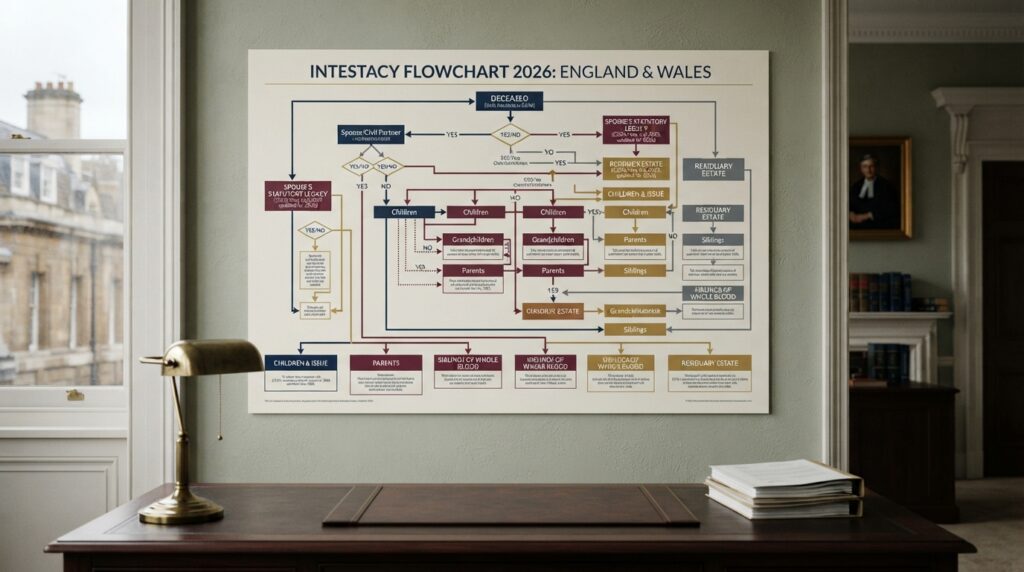
The 2026 intestacy flowchart in words
Here is the order the law follows in England and Wales.
- If there is a surviving spouse or civil partner and no children or other descendants, they inherit the whole estate.
- If there is a surviving spouse or civil partner and there are children or other descendants, the spouse or civil partner receives personal belongings, the first £322,000 (this is known as the Statutory Legacy, and was updated last in 2023), and half of the remaining estate. The other half is shared between the children or remoter descendants.
- If there is no surviving spouse or civil partner, the estate passes to children or remoter descendants.
- If there is no spouse and no descendants, the estate passes in order to parents, then full-blood siblings or their descendants, then half-blood siblings or their descendants, then grandparents, then full-blood aunts and uncles or their descendants, then half-blood aunts and uncles or their descendants.
- If no qualifying relative can be found, the estate passes to the Crown as bona vacantia.
Why the statutory legacy can still cause real problems
The statutory legacy sounds generous until you put a house into the picture. If someone dies with a spouse, children, a home in their sole name and not much cash, the surviving spouse may still end up sharing the estate with the children sooner than the family expected.
Example: if John dies intestate in 2026 leaving a house worth £500,000 and savings of £50,000, with a wife and two children, the total estate is £550,000. His wife would receive personal belongings, the first £322,000, and half of the remaining £228,000. The children would share the other half. On those figures, the wife receives £436,000 in value and the children share £114,000.
That can create pressure to sell or refinance the family home, especially where most of the estate is tied up in property rather than cash.
The cohabiting partner problem

One of the most damaging myths in this area is the idea of a common law marriage. Across the UK, the ONS says there were 3.5 million cohabiting-couple families in 2025. But living together does not give an unmarried partner automatic inheritance rights under the intestacy rules in England and Wales.
- Your partner does not automatically inherit under intestacy just because you lived together.
- They may have no immediate right to stay in a home that was in your sole name.
- They may need to bring a claim under the Inheritance (Provision for Family and Dependants) Act 1975, which can be stressful, slow and expensive.
This is one of the clearest examples of the gap between modern family life and the default legal rules.
Pensions and inheritance tax: why 2026 and 2027 matter
If you are searching around intestacy, pensions and inheritance tax, the timing matters. From 6 April 2026, reforms to Agricultural Property Relief and Business Property Relief restrict 100% relief to the first £2.5 million of qualifying combined agricultural and business property, with 50% relief above that. That is not an intestacy rule, but it does raise the stakes for families where business or farm assets are being passed on without clear planning.
From 6 April 2027, government plans bring many unused pension funds and death benefits into the estate for inheritance tax purposes. That does not mean every pension is simply distributed by intestacy rules, because scheme rules and nominations still matter. But it does mean poor estate planning can become more expensive, and the tax position around death benefits becomes harder to ignore.
In plain English: if you leave everything to default rules, there is more scope for the wrong people to inherit, and potentially more tax friction around the overall estate.
What about children, step-children and guardians?
Children inherit under intestacy. Step-children do not (unless they were legally adopted). If a child who is entitled under intestacy is under 18, their share is usually held for them in a trust until adulthood.
And yes, if both parents die without a will and there is no valid guardian appointment in place, the court may need to decide who should raise the children. A will lets you make that choice yourself. There is an official Government intestacy flowchart available here.
The probate process without a will

When there is no will, someone still has to deal with the estate. Instead of applying as an executor, the appropriate person applies for letters of administration and becomes the administrator.
The law controls who has priority to apply, broadly in line with the inheritance order. That can create delay and friction if the legally entitled person is not the person the family would naturally have chosen to handle things.
Intestacy versus making a will
| Issue | If you die intestate | If you make a will |
|---|---|---|
| Who inherits | The law decides in a fixed order, based on 100 year old statute! | You decide |
| Unmarried partners | No automatic right to inherit | Can be provided for clearly |
| Step-children | Usually excluded | Can be included |
| Guardians for children | The court may have to decide | You can appoint guardians |
| Tax planning | No control over structure | More room for proper planning |
| Administration | Letters of administration required | Executors can act under the will |
Frequently asked questions
Common questions.
Usually yes if you are still legally married or in a civil partnership at the date of death. Separation alone does not remove those rights. Divorce or dissolution normally does.
In England and Wales, marriage or civil partnership usually revokes an existing will unless it was made in contemplation of that marriage or civil partnership.
It means the estate passes to the Crown because no qualifying relative can be found under the intestacy rules.
No. Many pension death benefits depend on the scheme rules, trustee discretion and any nomination you made. But the wider inheritance tax position is changing from 6 April 2027.
If you want your partner, children or specific loved ones protected properly, a will is still the simplest way to stay in control. Book a consultation if you want clear advice in plain English.
Sources: GOV.UK intestacy checker, HMRC statutory legacy guidance, GOV.UK APR/BPR reforms, GOV.UK pension IHT changes, ONS Families and households 2025, National Wills Report 2025.